

Recruiting Is a Mess in Canada — And Everyone Knows It
Canada does not have a recruiting slogan problem. It has a trust, standards, identity, and veteran-treatment problem.
Canada has a recruiting problem, and pretending otherwise is not going to fix it.
The Canadian Armed Forces have spent years trying to modernize, adjust, rebrand, soften edges, rewrite culture, and make the institution look more welcoming. Some of that was likely needed. No serious person is arguing the military should be frozen in 1955, locked on a parade square, and guarded by a sergeant-major with a moustache and a hatred of happiness.
But there is a difference between thoughtful reform and throwing everything into a blender because someone in Ottawa found a new buzzword.
Right now, recruiting feels like a mess because the institution seems unsure what it is trying to sell.
Is it selling service?
Is it selling identity?
Is it selling a career?
Is it selling a cause?
Is it selling belonging?
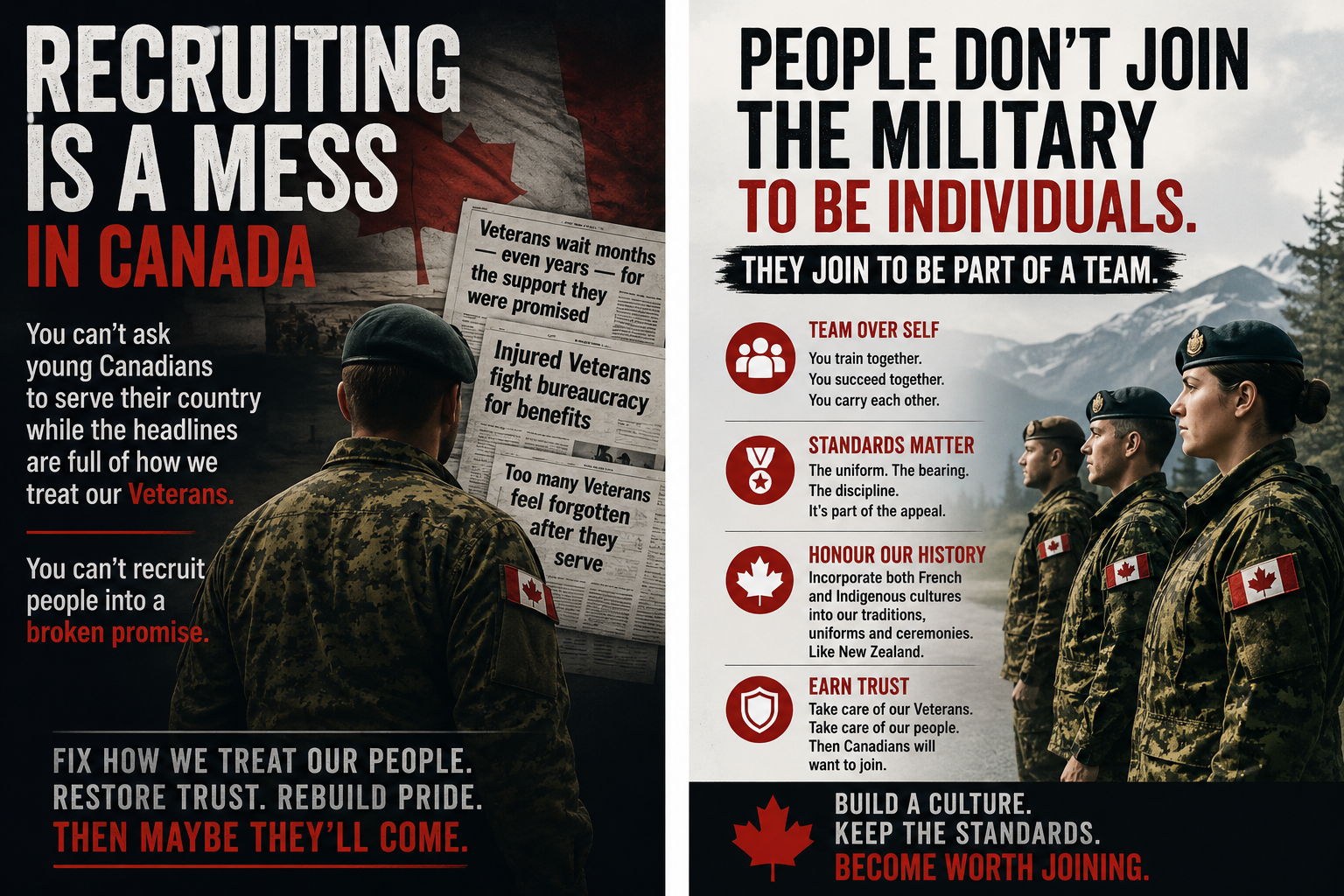
Because people do not usually join the military to become a loose collection of individuals with matching pay stubs. They join because they want to be part of something bigger than themselves. They join for the team. The unit. The tradition. The challenge. The uniform. The standards. The pride. The idea that when things go sideways, the person beside you matters as much as you do.
That is not outdated thinking.
That is the entire point.
You Cannot Recruit People Into a Broken Promise
One of the biggest recruiting problems in Canada is not a poster, a slogan, or a social media campaign.
It is trust.
Who looks at the headlines about how veterans are treated and thinks, “Yes, that looks like an organization that will have my back”?
Canadians see stories about injured veterans fighting for benefits, waiting for services, being buried in bureaucracy, or being treated like administrative problems after giving years of their lives to the country. Then the same system turns around and asks young people to sign up.
That is a hard sell.
You cannot tell people “serve your country” while the papers are full of examples suggesting the country may not serve them back when it matters.
Recruiting begins long before someone walks into a recruiting centre. It begins with public confidence. It begins with how serving members are treated. It begins with how veterans are treated. It begins with whether families believe the sacrifice is respected after the uniform comes off.
Right now, that confidence is damaged.
Diversity Without Deep Thought Is Just Another Policy Exercise
Canada is a diverse country. The military should reflect that.
That part is not controversial.
The problem is when diversity becomes a shallow administrative project instead of a serious cultural one. Too often, change appears to be pushed from the top down without enough thought about what actually binds a military together.
A military cannot simply be a workplace with camouflage.
It is not just another department. It is not a call centre with rifles. It is not a branding exercise with boots.
The military depends on shared identity, shared standards, shared discipline, and shared purpose. If diversity is introduced in a way that weakens those things instead of strengthening them, then the institution loses the very glue that makes it work.
Real inclusion should not mean stripping away tradition until nothing is left.
It should mean expanding tradition intelligently.
Canada has deep French military heritage. Canada also has Indigenous warrior traditions, symbols, languages, histories, and ceremonies that could be respectfully and meaningfully incorporated into military identity.
Not as token gestures.
Not as a land acknowledgement stapled onto a PowerPoint deck.
But as living parts of military culture.
Look at New Zealand. The New Zealand Defence Force has incorporated Māori culture into military identity in a way that is visible, powerful, and rooted. It gives people something larger to belong to. It does not erase military tradition; it deepens it.
Canada could do something similar if it had the courage and imagination.
Imagine dress uniforms, ceremonies, unit traditions, music, and symbols that properly reflected French Canada, Indigenous Canada, and the full story of this country’s military past. That would be far more meaningful than another policy memo with the emotional impact of a wet sock.
Standards Matter
The relaxing of standards around dress, deportment, and military presentation has not helped recruiting.
In fact, it may have done the opposite.
People do not join the military because they want it to look and feel like every other job. They join because it is supposed to be different.
Standards are part of the appeal.
The uniform matters. Bearing matters. Discipline matters. Looking like a professional military force matters. When those things are watered down too much, the institution loses part of its identity.
Of course standards can evolve. They always have.
But evolution is not the same as surrender.
There is a reason people are drawn to the visual and cultural power of the military: the uniforms, the drill, the traditions, the ranks, the badges, the history. These things tell people they are joining something with weight behind it.
Take too much of that away and what remains?
A government job with worse hours, more risk, and a pension plan that may or may not survive the next round of political genius.
That is not exactly a recruiting slogan.
People Want a Team
The military has always been about the collective.
You train together.
You suffer together.
You succeed together.
You fail together.
You carry each other.
That is the part that matters.
Modern culture pushes individual identity hard. Everything is personalized, customized, branded, and self-focused. But the military cannot function if everyone is encouraged to see themselves primarily as an individual project.
A military needs people who can belong to something.
That does not mean erasing who they are. It means giving them a larger identity they choose to step into. A shared identity. A team identity.
That is what recruits are looking for, whether they can put it into words or not.
They want challenge.
They want purpose.
They want structure.
They want pride.
They want to know the person beside them is held to the same standard.
They want to be part of something real.
Canada Needs More Than a Recruiting Campaign
Canada does not need another glossy ad campaign pretending everything is fine.
It needs honesty.
It needs to fix how veterans are treated.
It needs to restore confidence among serving members.
It needs to stop confusing lower standards with accessibility.
It needs to build a military culture that is modern without being hollow.
It needs to honour diversity by making it part of shared tradition, not by replacing shared tradition with vague slogans.
It needs to remember that people do not join the military to be celebrated as individuals.
They join to become part of a team.
And until Canada understands that, recruiting will remain exactly what it looks like now:
A mess.
Pull Quotes
“The Canadian Armed Forces cannot recruit people into a broken promise.”
“People do not join the military to become a loose collection of individuals with matching pay stubs.”
“Real inclusion should not mean stripping away tradition until nothing is left. It should mean expanding tradition intelligently.”
“The uniform matters. Bearing matters. Discipline matters. Looking like a professional military force matters.”
“People want to be part of something real.”
Canada does not have a recruiting slogan problem.
It has a trust problem.
Young people are being asked to serve while headlines are full of stories about veterans fighting bureaucracy, injured members being ignored, and standards being softened in the name of modernization.
People do not join the military to become part of a government branding exercise in boots.
They join for the team.
The unit.
The standards.
The pride.
The belief that they are stepping into something bigger than themselves.
Until Canada understands that, recruiting will remain exactly what it looks like now:
A mess.