
Canada’s Answer to We Didn’t Start the Fire — Except We Made It a Thing
Canadian rock has never received the respect it deserves.
The big names get their share of international airplay. Rush, Neil Young, Bryan Adams, The Guess Who, Bachman-Turner Overdrive, Alanis Morissette, Nickelback and a handful of others broke through in a major way. But taken as a whole, Canadian rock has never been marketed, mythologized or exported with anything close to the force of British or American music.
The United States had the machinery. Britain had the mythology. Canada had the bands.
And there were a hell of a lot of them.
I spent my high-school years not far from Toronto, at exactly the right time to watch a remarkable Canadian music scene unfold. One of the landmarks for me was the arrival of Q107 FM at 107.1, the Mighty Q. The station went on the air in 1977 with an album-oriented rock format, broadcasting from the CN Tower. Even better, one account of its launch identifies the first song played as Murray McLauchlan’s “Hard Rock Town.” That seems almost too perfect. Broadcasting History
Q107 mattered because it did something Canadian radio desperately needed: it treated Canadian rock as something worth putting beside Zeppelin, Pink Floyd, The Who and the Stones rather than something that had to apologize for being Canadian.
And then there was Homegrown.
The Q107 Homegrown competition gave unsigned musicians something that was almost impossible to get otherwise: a real audience. Bands could submit material, selected songs made it onto the Homegrown albums, and suddenly musicians who had never been inside a major-label studio could find themselves coming out of speakers across Southern Ontario.
Some of those names disappeared. Others went a very long way.
The first Q107 Homegrown competition in 1979 was won by Ravin’, a Toronto jazz-funk-rock group whose “Yeah For Sure” appeared on the first Homegrown LP. That first album also included performers such as Molly Johnson, long before she became one of Canada’s best-known jazz and blues singers. Rick Morrison Music
The 1980 Homegrown collection gives you an idea of just how broad the scene was: The Paul James Band, Truths & Rights, Trixie Goes Hollywood, Popular Spies and others all appeared. Truths & Rights won recognition through the contest with “Acid Rain,” one of the early examples of Toronto reggae finding space on mainstream FM rock radio. Canada Black Music Archives
Then came one of the great Canadian-radio success stories.
In 1983, Honeymoon Suite submitted “New Girl Now” to the Q107 Homegrown Contest and won. That exposure helped lead directly to a multi-album deal with WEA Canada. Within a year they had a major-label album out; eventually “New Girl Now,” “Burning in Love,” “Stay in the Light,” “Wave Babies” and “Feel It Again” became part of the Canadian rock soundtrack. Honeymoon Suite Band
They weren’t the only band to benefit from the machinery around Homegrown. Boys Brigade had “Mannequin” selected for the 1981 Homegrown album. That helped put them in the orbit of Rush’s organization; Geddy Lee ultimately produced their debut album. Brighton Rock, before adopting that name, had “Breaking Down the Barricade” selected for the 1984 Homegrown album and later signed with WEA. Wikipedia
That is what Canadian radio could do when it actually backed Canadian musicians.
Before arena rock, there were gymnasiums
There is another part of this history that gets forgotten.
Before these people played arenas, a surprising number of them played high schools, hockey arenas, bars, Legion halls, colleges and every other room where somebody could run enough extension cords to a PA system.
Rush didn’t materialize fully formed at Maple Leaf Gardens. Their own touring history records dates at Ontario high schools, including Laura Secord Secondary School, Banting Memorial High School and Brock District High School. Their early career was built in large part on the Ontario high-school circuit before the drinking age dropped and clubs became more accessible to them. Rush.com
Max Webster did essentially the same thing. Contemporary coverage described them as fixtures of the Ontario barroom and high-school scene before they broke into theatres and arenas. People of a certain age all over Ontario still have the same improbable story: Yeah, Max Webster played our high school. And quite often, they really did. Max Webster Live
That was the ecosystem.
A band could start in a basement, play the school gym, graduate to a bar, open at an arena, get some FM airplay and, if everything went right, make a record.
Not Nashville.
Not Los Angeles.
Not London.
Barrie. Hamilton. Toronto. Sudbury. Kingston. Winnipeg. Vancouver. Halifax. Montreal.
That matters.
And then there was Attic
One correction is worth making because the story is actually more interesting this way: Attic wasn’t a studio; Attic Records was one of Canada’s most important independent record labels.
Founded in 1974 by Alexander Mair and Tom Williams, Attic developed and released a remarkable amount of Canadian music. Its roster over the years included names such as Triumph, Teenage Head, Lee Aaron, Anvil and The Nylons, among many others. By the late 1980s it had grown into Canada’s largest independent record company. Onam Records
That independent infrastructure was tremendously important. Canada did not have a Los Angeles-sized recording industry waiting around every corner. Labels like Attic, Anthem and Aquarius, radio stations like Q107, producers, small studios, managers, promoters and club owners collectively created the machinery that allowed Canadian rock to exist.
And much of that history came from an era before anybody imagined that every recording would someday be instantly available forever.
There was no cloud backup.
No Spotify.
No hard drive containing twenty thousand sessions.
There were reels of tape, acetates, cassettes, vinyl masters, safety copies, radio station archives and filing cabinets.
Some survived.
Some changed hands.
Some wound up in corporate catalogues.
Some are sitting in private collections.
And some Canadian recordings appear simply to have disappeared.
I would be careful about saying that Attic’s master tapes themselves were broadly “lost,” because the Attic catalogue ultimately changed ownership and ended up with Unidisc. But the larger point absolutely stands: a great deal of Canadian music from that period was poorly archived, never digitized, never commercially reissued, or effectively vanished from public circulation. Onam Records
For people who were there, that’s frustrating because we remember bands that were every bit as good as acts that eventually became household names.
They simply never got preserved the same way.
There is a Canadian sound
This is where things become subjective, but I think Canadians who grew up with this music know what I mean.
Canadian rock has a sound.
Not one sound—Rush certainly doesn’t sound like Blue Rodeo, and The Tragically Hip doesn’t sound like Voivod—but there is something recognizable running through a surprising amount of it.
American rock, particularly at its commercial peak, could be extraordinarily polished. Everything placed perfectly. Everything compressed, layered, doubled and buffed until it shone.
British rock often embraced the opposite: abrasion, eccentricity, experimentation and deliberate rough edges.
Canadian records frequently landed somewhere between the two.
There was polish, but often not too much of it.
There were rough edges, but rarely just for the sake of being rough.
Bass, guitar and drums were often allowed to sound like bass, guitar and drums. Vocals weren’t always scrubbed clean. Arrangements could be relatively straightforward. Production budgets often weren’t enormous, which ironically meant that some records retained an immediacy that bigger productions lost.
The result was something that often sounded slightly colder, leaner and more spacious.
Canadian.
Listen across generations and genres and you’ll hear different versions of it: The Guess Who, April Wine, Rush, Max Webster, Streetheart, Teenage Head, Blue Rodeo, The Tragically Hip, Big Sugar, Sloan, The Tea Party, Matthew Good, The Trews.
Completely different bands.
Yet somehow they belong in the same forest.
We could tell stories, too
Canadian songwriters have also been badly underestimated internationally.
Neil Young, Tom Cochrane and Gord Downie could tell a story every bit as effectively as the celebrated American writers they are usually compared against.
Bruce Springsteen can make a highway, a factory and a dying town into mythology.
Bob Dylan can turn history into a conversation.
Fine.
Canada has writers who could do that too.
Gord Downie could take a hockey player, a prison escape, a small Ontario town, a nautical disaster or some obscure line from Canadian history and turn it into something millions of people suddenly cared about.
Tom Cochrane could make the Trans-Canada Highway feel like philosophy.
Neil Young could reduce an entire emotional landscape to three chords and a voice that technically shouldn’t work—and somehow make it devastating.
Gordon Lightfoot belongs in that conversation as well. “The Wreck of the Edmund Fitzgerald” alone should have settled that argument decades ago.
Canadian writers weren’t merely writing songs.
They were documenting the place.
We could play loud, too
Then there is the strange way Canadian hard rock tends to disappear when people start reminiscing about the 1980s.
Mention eighties hard rock and suddenly everything is:
Mötley Crüe.
Ratt.
Poison.
Cinderella.
Bon Jovi.
Def Leppard.
All right.
But Helix could absolutely go toe-to-toe with that crowd.
So could Honeymoon Suite, Coney Hatch, Brighton Rock, Killer Dwarfs, Kick Axe, Headpins, Lee Aaron, Anvil and half a dozen others.
Helix didn’t require an apology for being Canadian. Put “Rock You” through a big PA system and the nationality question becomes fairly irrelevant.
Canada had its own metal scene, its own punk scene, its own progressive scene and its own bar-rock circuit. Some of it went international. A lot of it never got the American promotional push necessary to become part of the accepted history of rock.
That isn’t the same thing as not being good enough.
And the women were already there
The same thing happens when rock history discusses women.
By the time Sheryl Crow became a major international rock star in the 1990s, Canadian women had already spent years demonstrating that a woman fronting a rock record didn’t need to be treated as a novelty.
Holly Woods and Toronto were doing it.
Darby Mills and the Headpins were doing it.
Alannah Myles took “Black Velvet” around the world.
Sass Jordan was making records with enough grit to stand beside almost anybody on American rock radio.
Add Lee Aaron, Rough Trade’s Carole Pope, Dalbello, Lorraine Segato, Martha Johnson, and later Alanis Morissette, and the idea that Canada was somehow waiting for somebody else to show us how women fit into rock becomes ridiculous.
They were already here.
We just didn’t always export the story.
Maybe that’s the problem
Britain became extraordinarily good at selling its musical mythology.
Liverpool.
Manchester.
The British Invasion.
Punk.
New Wave.
Heavy metal.
Britpop.
America did the same thing.
Memphis. Detroit. Laurel Canyon. Greenwich Village. Seattle. Sunset Strip. CBGB. Motown. Muscle Shoals.
Those places became chapters in the official history of popular music.
Canada had Yorkville, Queen Street West, the Ontario high-school circuit, Montreal, Winnipeg, Vancouver, Halifax, the Horseshoe, the El Mocambo, Le Coq d’Or, the Gasworks, Larry’s Hideaway, the Kee to Bala, Maple Leaf Gardens and a thousand hockey arenas and bars spread across the country.
But we never packaged the story nearly as well.
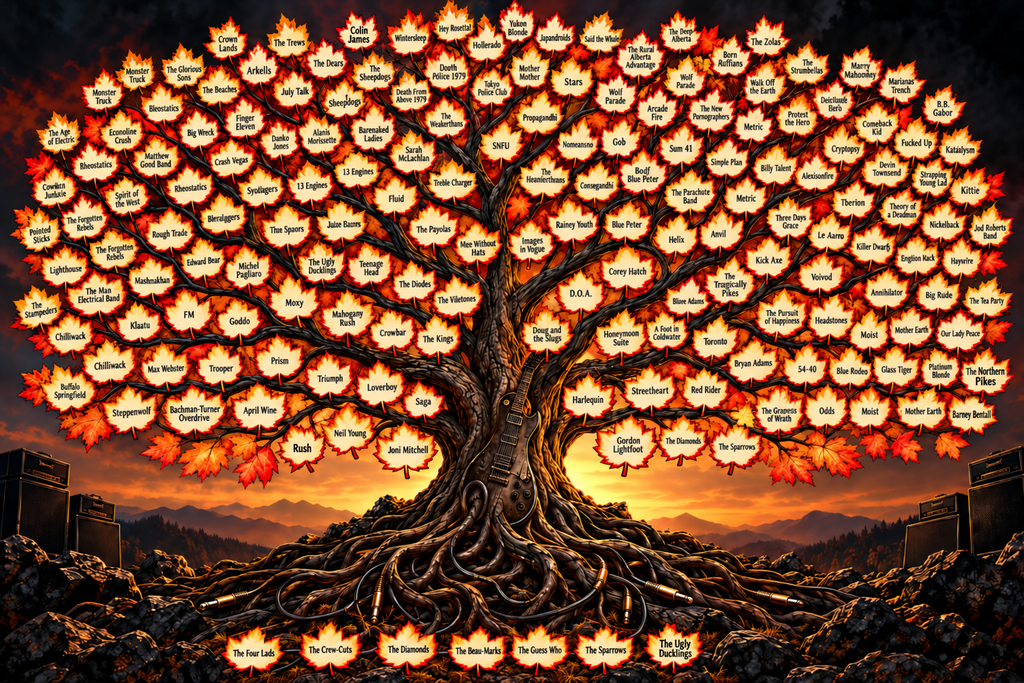
Maybe that is why I started building this Canadian Rock Tree.
The roots aren’t decoration.
They matter.
The Beau-Marks, The Diamonds, The Crew-Cuts, The Hawks, The Sparrows, The Guess Who and the other early acts created something for the next generation to grow out of. Then came Neil Young, The Band, Steppenwolf, Rush, BTO, April Wine and Max Webster. From them the branches spread outward again—punk, prog, metal, new wave, roots rock, alternative, indie.
Eventually you get to The Tragically Hip, Sloan, Blue Rodeo, The Tea Party, Our Lady Peace, Big Wreck, Billy Talent, Metric, Arcade Fire, The Sheepdogs, The Beaches and another generation still being written.
It isn’t a list of bands.
It’s a lineage.
And once you put a couple hundred Canadian artists on one tree, something becomes fairly obvious:
Canada didn’t just contribute to rock and roll.
We made it a thing.
Verse 1
Radio crackle, basement drums,
Toronto nights and prairie runs,
Hawkins howling, Yorkville loud,
Guess Who breaking through the crowd.
Neil goes south with Buffalo,
Joni paints the undertow,
Steppenwolf lets engines roar,
The Band comes kicking through the door.
Chorus
Turn it up, Canada, turn it loud,
Basement amps and barroom crowds,
From the Lakes to the Pacific line,
Cold outside but the sound was fire.
Turn it up, Canada, let it roll,
Guitars, sweat and northern soul,
Every town had a stage somewhere,
And somebody cranking a battered snare.
Verse 2
Rush goes strange and Rush goes huge,
BTO with nothing to lose,
April Wine and Max Webster,
Triumph pushing even harder.
Chilliwack and Streetheart too,
Trooper knew what crowds would do,
Prism lights and Loverboy,
Cheap guitars making teenage noise.
Verse 3
Teenage Head and D.O.A.,
Viletones tearing rules away,
Rough Trade shaking up the room,
Spoons and Payolas in full bloom.
Platinum Blonde, Glass Tiger shine,
Northern Pikes hit right on time,
Hip comes roaring out of bars,
Blue Rodeo under prairie stars.
Chorus
Turn it up, Canada, turn it loud,
Basement amps and barroom crowds,
From Halifax to Vancouver rain,
Every province had a different strain.
Turn it up, Canada, shake the floor,
One more song and one encore,
You could hear it through a snowbank wall,
We were never quiet after all.
Verse 4
Sloan with hooks, Tea Party dark,
Big Sugar throwing sparks,
Headstones kicking, Moist comes through,
I Mother Earth with something new.
Our Lady Peace on radio waves,
Matthew Good with darker days,
Finger Eleven, Big Wreck sound,
Nickelback takes it worldwide.
Verse 5
Sum 41 comes crashing in,
Billy Talent razor grin,
Alexisonfire burns the stage,
Arcade Fire turns the page.
Metric cool and Stars shine bright,
Broken Social Scene all night,
Sheepdogs keep the old flame lit,
Beaches prove there’s life in it.
Bridge
Not one sound and not one town,
French or English, underground,
Metal, punk, prog, roots and blues,
Garage bands with nothing to lose.
From Sudbury bars to Montreal,
Winnipeg winters, Kingston halls,
Every generation grabbed the wire,
Plugged it in and made it higher.
Final Chorus
Turn it up, Canada, turn it loud,
Raise the glass and face the crowd,
No imported story, no borrowed name,
We built our own damn wall of flame.
Turn it up, Canada, let it ring,
Every garage learned to sing,
Maple roots and Marshall stacks,
Crank it once and don’t look back.